
 |
 |
 |
 |
 |
 |
 |
 |
 |
 |
 |


The History of Black History
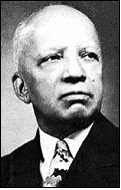 Beginning in 1926 as "Negro History Week," Americans around the country now celebrate Black History Month. But who chose it and why February?
Carter G. Woodson (photo right) created Negro History Week. The goal was to "popularize the truth . . . [we] are not interested so much in Negro History as in history influenced by the Negro." Dr. Woodson, considered by many to be the "Father of Black History," chose the second week in February because of the birthdays of Frederick Douglass and Abraham Lincoln. The celebration of Negro History Week continued; however, in the early 1960s the word "Negro" was replaced with "black" and "African American." The week of celebration was then called "Black History Week.." In 1976 America celebrated its Bicentennial, at this time, Black History Week became the celebration that we know as "Black History Month.”
Carter Woodson, the founder of Black History Month, was born to parents who were former slaves. He spent his childhood working in the Kentucky coal mines and enrolled in high school at age twenty. He graduated within two years and later went on to earn a Ph.D. from Harvard. Woodson was disturbed to find that history books largely ignored the black American population—and when they did it was generally in ways that reflected an inferior social position.
Woodson decided to take on the challenge of writing black Americans into the nation's history. He established the Association for the Study of Negro Life and History (now called the Association for the Study of Afro-American Life and History) in 1915, and a year later founded the widely respected Journal of Negro History. In 1926, he launched Negro History Week as an initiative to bring national attention to the contributions of black people throughout American history.
As written above, Dr. Woodson chose the second week of February for Negro History Week because it marks the birthdays of two men who greatly influenced the black American population, Frederick Douglass and Abraham Lincoln. However, February has much more than Douglass and Lincoln to show for its significance in black American history. For example:
- February 23, 1868:
W.E.B. Dubois, important civil rights leader and co-founder of the NAACP, was born. - February 3, 1870:
The 15th Amendment was passed, granting blacks the right to vote. - February 25, 1870:
The first black U.S. senator, Hiram R. Revels (1822-1901), took his oath of office. - February 12, 1909:
The National Association for the Advancement of Colored People (NAACP) was founded by a group of concerned black and white citizens in New York City. - February 1, 1960:
In what would become a civil rights movement milestone, a group of black Greensboro, N.C., college students began a sit-in at a segregated Woolworth's lunch counter. - February 21, 1965:
Militant leader Malcolm X, who promoted Black Nationalism, was shot to death by three Black Muslims.